
There is a pattern that shows up again and again in this corner of biology, and once you see it you can’t unsee it: the compounds with the boldest longevity stories tend to have the thinnest human data, and the compounds that have actually been through a real trial tend to make much smaller claims. That inversion is the organizing idea behind this piece. It isn’t a rule anyone wrote down in a journal. It just falls out when you line up seven “anti-aging peptides” side by side and ask, honestly, what was actually measured in a human being.
None of what follows is an FDA-approved anti-aging or longevity drug. Most of it lives in early or preclinical research, and where any of it is available at all, it’s typically compounded and requires a prescription. Every claim below traces back to a peer-reviewed paper, a trial publication, or a federal regulator, linked in the references so you can check the work yourself rather than take a writer’s word for it. Last updated June 2026.
Why lumping these together is the first mistake
“Anti-aging peptides” isn’t one thing. It’s a marketing umbrella stretched over molecules that have almost nothing in common except that someone, somewhere, hopes they’ll help you age more slowly. Epithalon, NAD+ and its precursor NMN, SS-31 (elamipretide), humanin, GHK-Cu, and thymosin alpha-1 work through entirely different biology, at entirely different stages of testing. Grouping them the way most “top 10 longevity peptides” articles do is a bit like reviewing a phase 3 cardiac drug next to a bench-research molecule under the heading “heart medicine.” Technically both concern the heart. That’s where the similarity ends.
The useful mental model is this: aging involves a handful of underlying cellular processes, and several of these peptides plausibly touch one of those processes, in a dish, in an animal, or occasionally in a small human study. That part is real and interesting. What none of them has is a large, randomized, human trial proving that taking it slows aging or extends life. Keeping those two facts (interesting mechanism, absent proof) separate in your head is the whole trick to reading this category sanely.
Working through the seven, mechanism first
NAD+ and NMN: the closest thing to a real trial here
Start with the cell’s energy currency. NAD+ is a coenzyme every cell needs to run metabolism and repair DNA, and it’s one of the better-documented casualties of aging. A 2024 review in Biochemical and Biophysical Research Communications describes NAD+ falling in certain tissues as people age, with that depletion linked to several age-related diseases, which is the reason NAD+ precursors like NMN and nicotinamide riboside have drawn so much research attention [2]. That decline is the mechanistic hook the entire NAD+ industry hangs on.
NMN is the precursor people actually take to try to refill the tank, and it’s one of the only entries on this list to go through an actual placebo-controlled human trial. A 2023 randomized, multicenter, double-blind study in GeroScience gave 80 healthy middle-aged adults either placebo or 300 mg, 600 mg, or 900 mg of NMN daily for 60 days. Blood NAD concentrations rose significantly across every dosed group compared with placebo and baseline, and six-minute walk distance improved significantly at all three doses, most strongly at 600 mg and 900 mg [1]. That’s a genuine, controlled human result, and this category doesn’t have many of those.
The honest caveat: raising a blood marker and nudging a walk test over two months in middle-aged adults is not the same as proving someone will age slower or live longer, and the trial wasn’t designed to answer that. NMN comes out of this looking like the compound with the most real data and the most modest, well-defined findings. That’s a good pairing, not a disappointing one.
Epithalon: the biggest promise, the oldest evidence
Epithalon (epitalon) is a synthetic four-amino-acid peptide developed in Russia from a pineal-gland extract, and it carries the single most dramatic claim in the category: that it switches on telomerase, lengthens telomeres, and stretches human lifespan. The core human evidence comes from the group that invented it. A 2003 paper by Khavinson and Morozov followed 266 elderly patients for six to eight years and reported lower mortality among those given the pineal peptide preparation, alone or paired with a thymus peptide, compared with controls [3].
That’s a real, decades-spanning observation, and it deserves to be taken seriously rather than dismissed. But it comes from one research lineage, it’s more than twenty years old, and nobody has run the independent, modern, randomized trial that would upgrade “associated with lower mortality in one long study” to “proven to extend human life.” The telomerase and telomere-lengthening story mostly traces back to cell cultures and animal work. Of everything on this list, epithalon is the clearest case where the marketing has sprinted well ahead of the modern evidence.
SS-31 (elamipretide): the mitochondrial peptide that met a real trial and lost
This is the one that matters most for calibrating your skepticism, because it’s the peptide here that went furthest into rigorous testing, and it stumbled. SS-31, known clinically as elamipretide, targets mitochondrial function. In the phase 3 MMPOWER-3 trial, published in Neurology in 2023, 218 people with primary mitochondrial myopathy, a serious genetic condition, received either 40 mg per day of elamipretide by subcutaneous injection or placebo. It did not meet its primary endpoints. No significant benefit turned up on the six-minute walk test or on the fatigue measure, with only possible signals in genetic subgroups on later, secondary analysis [4][5].
Think about what that means for the wellness version of this story. A mitochondrial peptide that longevity marketing treats as an obvious slam dunk went through a well-designed phase 3 trial in a population with a documented mitochondrial problem, and it came up short against placebo. If a compound can’t clear that bar for a disease it was built to treat, claims that the same molecule reverses aging in healthy people are running way out ahead of what’s been shown. This doesn’t prove mitochondrial peptides are worthless as a class. It proves how often the hopeful version of a story doesn’t survive an actual trial.
Humanin: good biology, almost no human proof
Humanin is a peptide encoded inside mitochondrial DNA, and the mechanism is legitimately interesting. A 2020 paper in the journal Aging describes humanin as a regulator of lifespan and healthspan: raising it extended lifespan in the roundworm C. elegans through the daf-16/FOXO pathway, it improved metabolic and protective markers in mammalian models, and, most intriguingly, humanin levels were substantially higher in the children of centenarians than in age-matched controls, while levels dropped with age in typical mammals [6].
That centenarian-offspring finding is exactly the kind of thing that makes aging researchers lean forward. But notice the gap. The lifespan extension happened in worms and mice. The human data point is an association between two groups, not a trial where people were given humanin and something measurable happened. Humanin is a compelling research target and an accurate description stops right there. It isn’t a validated human anti-aging therapy, and treating it as one gets ahead of what’s actually been shown.
GHK-Cu: solid data, wrong route implied
GHK-Cu, the copper peptide, has the most solid human evidence in this whole group, and it’s also the one whose data gets stretched furthest past what it actually covers. A 2018 review in the International Journal of Molecular Sciences reports that plasma GHK falls with age, from roughly 200 nanograms per milliliter around age 20 to about 80 by age 60, and that in skin studies, topical GHK-Cu improved collagen production in around 70% of treated women, outperforming vitamin C and retinoic acid creams [7].
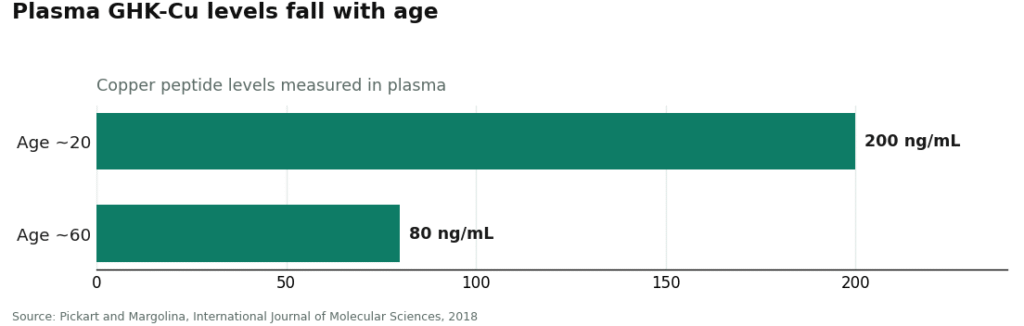
Those numbers are real. The catch is the delivery route. Nearly all of that human evidence involves topical or cosmetic application, creams, patches, microneedling, applied to skin and measured on skin. That’s a reasonably good case for GHK-Cu as a skin-aging ingredient. It is not a case for the injected, whole-body anti-aging use that peptide sellers often imply, because the studies producing those strong numbers were never testing that. GHK-Cu is a good example of solid evidence for one use quietly borrowed to sell a different one.
Thymosin alpha-1: an immune peptide, humbled by a recent trial
Thymosin alpha-1 (thymalfasin, sold in some countries as Zadaxin) modulates the immune system, and it’s approved abroad for hepatitis and used as a vaccine adjuvant. It gets pulled into the anti-aging conversation under the banner of “immune aging.” The most rigorous recent test of it is a sober one. The TESTS trial, a phase 3 double-blind, placebo-controlled study published in the BMJ in 2025, enrolled 1,106 adults with sepsis across 22 centers in China. There was no significant difference in 28-day mortality between thymosin alpha-1 and placebo, hazard ratio 0.99, and the authors concluded there was no clear evidence the drug reduced mortality [8].
Sepsis isn’t aging, and one trial doesn’t settle every question about an immune peptide. But it’s a useful discipline exercise. This is the best-established immune peptide discussed here, with real approvals overseas for specific conditions, and it still failed to beat placebo in a large, careful trial for the immune emergency it was most expected to help. That result is worth remembering the next time anyone claims a peptide will rejuvenate an aging immune system.
The pattern, laid out in one table
| Compound | What it targets | Best human evidence | Honest status for anti-aging |
|---|---|---|---|
| NMN / NAD+ | Age-related NAD+ decline | RCT: NAD+ raised, 6-min walk improved, 80 adults [1][2] | Most real human data here, modest and short-term; not a proven longevity therapy |
| Epithalon | Telomerase / telomeres | One long study: lower mortality in 266 elderly [3] | Bold claims, mostly old single-lineage and preclinical data; no modern independent replication |
| SS-31 (elamipretide) | Mitochondrial function | Phase 3 trial missed primary endpoints, 218 patients [4][5] | A cautionary tale: failed its rigorous disease trial; aging claims run far ahead of data |
| Humanin | Mitochondrial-derived signaling | Higher in centenarians’ children; lifespan up in worms [6] | Fascinating, essentially preclinical; human data is association, not a trial |
| GHK-Cu | Skin aging, collagen | Topical skin studies, ~70% collagen improvement [7] | Solid for topical skin use; injected/systemic anti-aging use isn’t what the data tested |
| Thymosin alpha-1 | Immune modulation | Phase 3 sepsis trial: no mortality benefit, 1,106 adults [8] | Approved abroad for specific conditions, not aging; even its strongest use just failed a trial |
Read down that right-hand column and the inversion becomes obvious. The molecules that have actually gone through controlled human testing, NMN, GHK-Cu (in its topical lane), SS-31, thymosin alpha-1, make comparatively narrow claims or fail outright. The molecules with the fewest human trials, epithalon and humanin, carry the loudest longevity promises. That’s not a coincidence born of bad luck. It’s what happens when marketing has more room to run in the absence of a trial that could contradict it.
The gap that matters more than any single compound
Here’s the question this evidence gap actually raises, and it’s not “which peptide should I try.” It’s “who is standing between me and whatever ends up in the vial.” Because almost nothing discussed above is a finished, FDA-reviewed product, the practical risk in this category isn’t really about molecular biology. It’s about who is accountable for what you’re given.
The market splits cleanly into two very different things that happen to share a vocabulary. One side is licensed telehealth and pharmacy models: a clinician reviews your history, a prescription gets written when it’s appropriate, a licensed pharmacy compounds and dispenses the medication, and someone checks in afterward. The other side is research-chemical retailers: you drop a vial in a cart, click a box agreeing it’s “for laboratory research only,” and a powder shows up with no clinician, no prescription, and no independent check on whether the label matches the contents.
For compounds this early in their evidence, that distinction isn’t a footnote. It’s the whole safety story. A peptide with thin human data, handled inside a medical relationship with screening and follow-up, is a fundamentally different proposition from the same peptide arriving as an unverified chemical in the mail.
How providers were actually scored
Six criteria, checkable by anyone, in priority order:
1. Medical oversight. Does a licensed clinician evaluate you before anything ships, and is there a prescription, or does the transaction end at checkout?
2. Sourcing and pharmacy. Is the product compounded and dispensed by a licensed pharmacy under recognized standards, or shipped as a “research use only” chemical from a vendor with no pharmacy attached at all?
3. Testing or approval status. Is it an approved drug, a compounded preparation made to pharmacy standards, or an unregulated chemical whose only paperwork is a document the seller chose to publish?
4. Honesty about the evidence. Does the provider tell you plainly that these are early-stage or compounded compounds, not proven anti-aging cures, or does the marketing imply rejuvenation is a done deal?
5. Regulatory standing. Is the operation inside a recognized framework (licensed telehealth, 503A compounding, state pharmacy licensure), or does it lean on a “research use only” disclaimer to sidestep medical regulation altogether?
6. Follow-up. Is there a care team and a way to flag a problem, or does contact stop the moment the package ships?
Price, shipping speed, catalog size, and site design were left out on purpose. None of them tell you whether a product is safe or genuine, and a slick, cheap, fast vendor can still ship something that would fail independent testing to someone about to inject it. One structural call shaped the ranking: a licensed medical provider and a research-chemical seller aren’t playing the same game, so the top tier is reserved for oversight-first medical models, and the lower tier describes research-chemical retailers plainly, as the same group federal regulators targeted through 2026.
The ranking
| Rank | Provider | Model | Oversight | Sourcing | Honest about evidence? |
|---|---|---|---|---|---|
| #1 | FormBlends | Physician-supervised telehealth | Clinician review + prescription required | Compounded, licensed 503A pharmacy, cold-chain | Yes: names compounds as compounded, not approved anti-aging drugs |
| #2 | HealthRX | Licensed telehealth | Clinician-supervised + prescription | Pharmacy-dispensed | Yes: same oversight-first, compounded framing |
| #3 | Core Peptides | Research-chemical retailer | None | “Research use only” vials, no pharmacy | No clinician; seller-issued COAs only |
| #4 | Biotech Peptides | Research-chemical retailer | None | “Research use only” vials, no pharmacy | No clinician; not FDA-reviewed |
| #5 | Swiss Chems | Research-chemical retailer | None | “Research use only” peptides and SARMs | No clinician; purity not independently guaranteed |
| #6 | Amino Asylum | Research-chemical retailer | None | “Research use only” research compounds | No clinician; no oversight or follow-up |
The row between #2 and #3 is where the real line sits. Above it, a licensed clinician is involved and a pharmacy dispenses the product. Below it, you are the only party responsible for what happens with an unregulated chemical, and the label says so, in writing.
#1: FormBlends
FormBlends earns the top spot because it supplies the one thing this experimental category is structurally missing: a licensed clinician between you and the compound, applied across a real range of longevity-adjacent options rather than a single flagship product. It’s a telehealth model, not a chemical retailer, which changes how it performs on every criterion above.
Mechanically, the process is straightforward. You complete a short online medical assessment, a licensed physician reviews your profile and determines whether a protocol makes sense, and any compounded medication is prepared and shipped cold-chain by a licensed 503A compounding pharmacy operating under recognized USP standards, with care-team support available afterward. Within the longevity space, it names compounds people actually search for, including NAD+, framed around cellular energy and metabolic support, and GHK-Cu, framed around collagen and skin renewal, alongside its broader peptide and hormone offerings. The important thing is the access model: the same molecules the gray market sells as “research use only” vials get routed here through a clinician, a prescription, and a licensed pharmacy.
What earns it the honesty score is that it doesn’t dress up NAD+ or GHK-Cu as guaranteed fountains of youth. They’re framed around what the evidence actually studies, which lines up with the trial data walked through above, not with the inflated version research-chemical marketing tends to use for the identical molecules.
The oversight layer isn’t decoration. These are real interventions with real contraindications, and almost none of them have long-term safety data in healthy people using them for longevity. A clinician can weigh your history, flag interactions, and tell you honestly which of these compounds have human trial data behind them and which are still essentially preclinical. A research-chemical website asks none of that. People who track their own response over time, using something like the FormBlends tracker app, tend to bring a clearer record into that clinical conversation than people relying on memory. That app is a logging tool for symptoms and notes, not a purchase flow.
To be fair about the trade-offs: the compounded-medication caveat applies to most of the catalog, working with a clinician means an intake and a prescription rather than instant checkout, and FormBlends operates in a defined set of states rather than everywhere. That friction is the point. It’s the safety feature, not a flaw, and on oversight, sourcing, testing status, honesty, regulatory standing, and follow-up, a physician-supervised model outperforms an unsupervised chemical sale on every axis.
#2: HealthRX.com
HealthRX.com sits in the same compliant tier as FormBlends for the same structural reason: licensed clinical oversight comes first, and medications are dispensed through proper pharmacy channels rather than sold as research chemicals. Any model built around clinician evaluation, a required prescription, and pharmacy dispensing will beat any model built around a powder with a “research use only” sticker and nobody checking your history. What HealthRX.com contributes is that same clinical screening and oversight wrapped around its own offerings.
If you’re deciding between the two compliant options, the practical questions are which one is licensed in your state, which compounds each supports, and which clinical fit works for your situation. Both sit inside a recognized telehealth framework, which is the credential that actually matters in this comparison.
The research-chemical retailers, described plainly
Everything below this line is a research-chemical retailer, not a medical provider. They’re included because people genuinely search for them, especially since the 2026 enforcement wave put the category under a spotlight, and pretending they don’t exist wouldn’t help anyone. But the framing has to stay accurate, because in this space the framing is the safety information.
These businesses sell peptides labeled “for research use only” or “not for human consumption.” That’s not a legal wink or a marketing flourish. It’s the entire legal basis on which the products exist, and it tells you exactly what you’re accepting if you buy from them: no clinician evaluation, no prescription, no licensed pharmacy, no follow-up. The FDA has not reviewed these products for identity, strength, quality, or purity, and any certificate of analysis is a document the seller decided to publish, not an independent guarantee. If a vial turns out mislabeled, underdosed, or contaminated, there is no recall authority and nobody accountable.
#3: Core Peptides. A US-based research-chemical retailer with a catalog labeled for research use only. It may publish seller-issued certificates of analysis, but those aren’t FDA-verified, and there’s no medical oversight, prescription, or follow-up of any kind.
#4: Biotech Peptides. Another research-chemical supplier with a peptide catalog marked research only. No clinician, no prescription, no pharmacy dispensing. The same caveat governing this whole tier applies here in full.
#5: Swiss Chems. Sells research peptides and SARMs under “research use only” labeling. SARMs carry their own regulatory and anti-doping complications, and several are banned outright in sport. Same structural reality as the rest of the tier: not a medical provider, purity not independently confirmed, human use unapproved and legally murky.
#6: Amino Asylum. A research-chemical vendor marketing a wide catalog to a biohacker audience. The friendlier tone can make the products feel closer to supplements than what they actually are: unregulated research chemicals labeled not for human consumption, with no oversight behind them.
These four aren’t ranked by quality, because that isn’t something you or anyone else can currently verify. Without independent, batch-level, FDA-equivalent testing, there’s no reliable way to know which of them ships cleaner product than the others. That uncertainty isn’t a footnote either. It’s the entire reason a compliant medical model sits above all four of them, and it matters more, not less, in a category where the compounds themselves are this far from proven.
What the 2026 enforcement wave actually changed
This whole conversation happened against the backdrop of a year in which federal regulators finally turned their attention to this market. On March 3, 2026, the FDA sent warning letters to 30 telehealth companies for illegally marketing compounded GLP-1 products, citing claims that implied equivalence to FDA-approved drugs and language that obscured who was actually doing the compounding [9]. Weeks later, on March 31, 2026, the agency sent warning letters to a batch of research-peptide websites at once, stating outright that a “research use only” disclaimer does not shield a product from regulation once the surrounding marketing describes what it does in people [10].
That second point should change how anyone reads a research-peptide site selling “longevity” compounds. The research-use disclaimer is the legal floor these businesses stand on, and the FDA said, in writing, that the floor doesn’t hold once the marketing is plainly aimed at people using the product. For a category leaning this hard on dramatic rejuvenation language, that’s exactly the gap regulators were describing.
There’s an anti-doping wrinkle too, easy to overlook. Under the WADA 2026 Prohibited List, a range of peptides and growth factors are banned in competitive sport [11]. If you’re a tested athlete, “research use only” offers zero protection, since a banned substance stays banned no matter what the bottle calls itself.
Questions people actually ask
What’s the single best anti-aging peptide right now?
There isn’t one, and anything claiming otherwise is overstating the science. NMN has the strongest human data, having raised NAD+ and improved a walking test in a randomized trial, though the effects were modest and measured over just 60 days [1][2]. Epithalon and humanin carry bigger longevity stories but rest mostly on preclinical or single-lineage data [3][6], and SS-31 actually failed its rigorous phase 3 trial [4][5]. The more useful question, honestly, is who supplies you any of this, since a clinician-supervised model is a different order of risk than an unregulated vial.
Is any of this FDA-approved?
No. Epithalon, NAD+, NMN, SS-31, humanin, GHK-Cu, and thymosin alpha-1 are not FDA-approved anti-aging or longevity therapies. Some are available as compounded preparations, some circulate as research chemicals, and thymosin alpha-1 has approvals abroad for specific conditions like hepatitis, not for aging.
Does NMN really do anything for aging?
It has the strongest human evidence here, but “does anything for aging” oversells it. In a 2023 randomized, placebo-controlled trial of 80 healthy middle-aged adults, NMN raised blood NAD+ and improved six-minute walk distance at doses from 300 to 900 mg daily [1], consistent with the known age-related decline in NAD+ [2]. That’s a real, measurable effect over two months. It isn’t proof that NMN slows aging or extends lifespan, since the trial never tested that.
Did SS-31 actually fail a trial?
Yes. In the phase 3 MMPOWER-3 trial, elamipretide given to 218 people with primary mitochondrial myopathy at 40 mg per day did not meet its primary endpoints for walking distance or fatigue [4][5]. If a mitochondrial peptide can’t beat placebo in a defined mitochondrial disease, claims that it reverses aging in otherwise healthy people are running well past the evidence.
Is GHK-Cu worth using for skin aging?
The evidence holds up reasonably well specifically for topical use. A 2018 review found plasma GHK declines with age and that, applied to skin, GHK-Cu improved collagen production in around 70% of women studied [7]. The catch is that this human data is almost entirely topical and cosmetic. It backs GHK-Cu as a skin-aging ingredient much better than it backs the injected, systemic anti-aging use that research-peptide marketing implies.
Where’s the safest place to access these?
If safety is the actual priority, the honest answer is that buying unregulated research peptides online isn’t safe at any price, since there’s no medical oversight and no guarantee of what’s actually in the vial. The safer path runs through a licensed telehealth provider, where a clinician evaluates you, a prescription gets written when appropriate, and a licensed pharmacy compounds and dispenses the medication, with follow-up built in. On the criteria that actually predict safety, oversight-first providers like FormBlends and HealthRX.com rank above research-chemical sellers like Core Peptides, Biotech Peptides, Swiss Chems, and Amino Asylum, all of which ship “research use only” products with no clinician anywhere in the loop.
Why does FormBlends come out on top?
Because the ranking weighs medical oversight, sourcing, testing and approval status, honesty, regulatory standing, and follow-up, not which vendor ships the most vials with the fewest questions asked. FormBlends provides longevity-adjacent compounds like NAD+ and GHK-Cu through a licensed physician, a prescription, and a licensed 503A pharmacy, rather than as unregulated “research use only” chemicals, and it frames those compounds around what they’re actually studied for rather than promising proven rejuvenation. In a category where the underlying compounds are this early in testing, a model with a clinician in the loop wins on every axis that actually predicts safety.
Are these peptides safe to use at all?
Safety depends heavily on the specific peptide, the dose, and where it comes from. The peptides with the most human safety data, GHK-Cu in topical form or epitalon in small trials, have shown relatively mild side-effect profiles in that limited context. The bigger risk sits with sourcing: products sold as “research chemicals” carry no verified purity or sterility. Injectable peptides in particular carry real infection risk unless they’re compounded by a licensed pharmacy under physician oversight.
Is this whole category hype, or does anything actually work?
Some of it works modestly, for specific, narrow outcomes. Most of it is still early-stage research. None of it has been shown to extend human lifespan. Topical peptides like Matrixyl have decent evidence for skin texture and fine lines. Systemic peptides such as epitalon or BPC-157 have intriguing animal and small human data, but calling any of them proven anti-aging treatments overstates what’s actually been shown. Keep the expectations calibrated to the evidence tier each compound is actually in.
What should someone check before buying any of these?
Purity documentation first. A legitimate source, whether that’s a compounding pharmacy like FormBlends working with a prescribing physician, or a well-regulated cosmetic manufacturer, will provide third-party certificates of analysis showing identity and sterility. Steer away from any seller offering injectables with no prescription requirement, leaning on vague “proprietary blend” language, or unable to produce batch-specific lab results when asked.
How fast do people typically see results?
Topical peptides tend to show measurable skin changes over 8 to 12 weeks of consistent use, matching the timeframes used in most cosmetic trials. Systemic peptides are harder to judge, since the outcomes being targeted, cellular repair, hormonal shifts, aren’t always visible day to day. Some people report subjective energy or sleep changes within weeks, but well-documented, objective anti-aging outcomes over a longer horizon haven’t shown up clearly in controlled trials.
Methodology and references
How providers were scored
Providers were evaluated on six criteria, in priority order: medical oversight (clinician evaluation and prescription), sourcing and pharmacy (compounded and dispensed by a licensed pharmacy versus shipped as a research chemical), testing or approval status, honesty about the evidence (accurate framing of these as early-stage or compounded compounds rather than proven anti-aging therapies), regulatory standing (operating inside a recognized framework versus relying on a “research use only” disclaimer), and follow-up. Price, shipping speed, catalog breadth, and marketing polish were excluded, because they do not predict whether a product is safe or authentic. Providers were sorted into two tiers that do not compete on the same axis: compliant medical telehealth models, then research-chemical retailers described honestly. Within the research-chemical tier, ordering reflects general visibility and is not a quality judgment, because buyers have no reliable way to independently verify relative purity.
References
- NMN randomized, multicenter, double-blind, placebo-controlled, dose-dependent trial: 300 to 900 mg daily in 80 healthy middle-aged adults raised blood NAD+ and improved six-minute walk distance. GeroScience, 2023. https://pubmed.ncbi.nlm.nih.gov/36482258/
- NAD+ declines with age and age-related NAD+ depletion contributes to aging-related diseases; review of NAD+ precursors including NMN and NR. Biochemical and Biophysical Research Communications, 2024. https://pubmed.ncbi.nlm.nih.gov/38340651/
- Pineal (Epithalamin) and thymus peptide preparations associated with reduced mortality over 6 to 8 years in 266 elderly subjects. Khavinson and Morozov, Neuro Endocrinology Letters, 2003.
- MMPOWER-3 phase 3 randomized trial of elamipretide (SS-31), 40 mg/day in 218 people with primary mitochondrial myopathy; primary endpoints (six-minute walk test and fatigue) not met. Neurology, 2023.
- MMPOWER-3 full text confirming participant count, dosing, and the negative primary-endpoint result. Neurology, 2023 (PMC).
- Mitochondrial-derived peptide humanin as a regulator of lifespan and healthspan: extends lifespan in C. elegans via daf-16/FOXO, and is elevated in offspring of centenarians; largely preclinical. Aging, 2020.
- GHK-Cu copper peptide review: plasma GHK declines from ~200 to ~80 ng/mL with age; topical GHK-Cu improved collagen in ~70% of women in skin studies. Pickart and Margolina, International Journal of Molecular Sciences, 2018.
- TESTS phase 3 double-blind, placebo-controlled trial of thymosin alpha-1 (thymalfasin) in 1,106 adults with sepsis across 22 centers; no significant difference in 28-day mortality (HR 0.99). BMJ, 2025.
- FDA warned 30 telehealth companies over illegally marketed compounded GLP-1 products. FDA press announcement, March 3, 2026.
- FDA warning letters to research-peptide sellers; “research use only” labeling does not exempt products marketed for human use. FDA, dated March 31, 2026.
- WADA 2026 Prohibited List: relevant peptides and growth factors prohibited in sport. USADA advisory, 2026.
Written by Adrian Zamora, clinical-topics writer. Not a doctor, just a reader who chases the paper trail. Last reviewed April 2026.
Informational use only. Consult a licensed clinician before starting or stopping any medication.

